

Executive Travel Policy: 2026 Guide (Mistakes + Fixes)
.jpeg)


TLDR;
- An executive travel policy is a specialized set of travel rules for senior leaders. It covers governing cabin class, lodging tier, approval routing, duty of care, and exception handling at a level standard corporate travel policies don’t address.
- 91% of public companies maintain a formal executive travel policy; only 33% of private companies do, according to the NBAA. The gap is where most preventable mistakes happen.
- The default approval routing in standard travel & expense tools breaks for executive travel: the C-suite’s “direct manager” is often the CEO or the board, which neither scales nor makes sense. Tiered approval with documented exception paths is the fix.
- Group executive travel rules (e.g., “no more than N executives on the same flight”) are a board-level continuity issue for public companies. This is consistently raised as an unsolved need by enterprises we talk to.
- Executive travel policies that feel rigid get ignored. Policies that build in flexibility on the lines of refundable fares, exception workflows, 24/7 support, get followed and reduce cost simultaneously.


What is an executive travel policy?
An executive travel policy is a set of rules that governs how senior executives, C-suite leaders, and high-profile personnel travel for business. It builds on your standard corporate travel policy but accounts for the specific realities of executive travel: short-notice trips, premium cabin and lodging tiers, heightened duty-of-care obligations, and approval structures that don’t fit the default “submit-to-direct-manager” pattern.
Executive travel policies differ from standard T&E policies in four ways:
- Cabin and lodging tiers are typically more permissive (premium economy or business on long-haul flights; approved premium hotel brands).
- Approval routing uses role-based tiers rather than direct-manager defaults. For example, the CEO’s expense report shouldn’t sit in a CFO’s queue for a week.
- Duty of care obligations are stricter, often including 24/7 support, traveler tracking, and protocols for high-risk destinations.
- Booking flexibility accommodates last-minute changes, refundable fares, and exception workflows that standard policies don’t support.
In our internal conversations with finance, HR, and travel operations leaders across 2,500+ prospects, executive travel consistently surfaces as a policy gap even at companies with well-defined standard T&E policies. Public companies are much more likely to have solved it than private ones, the NBAA reports 91% of public companies have formal executive travel policies versus only 33% of private companies.
What should an executive travel policy include?
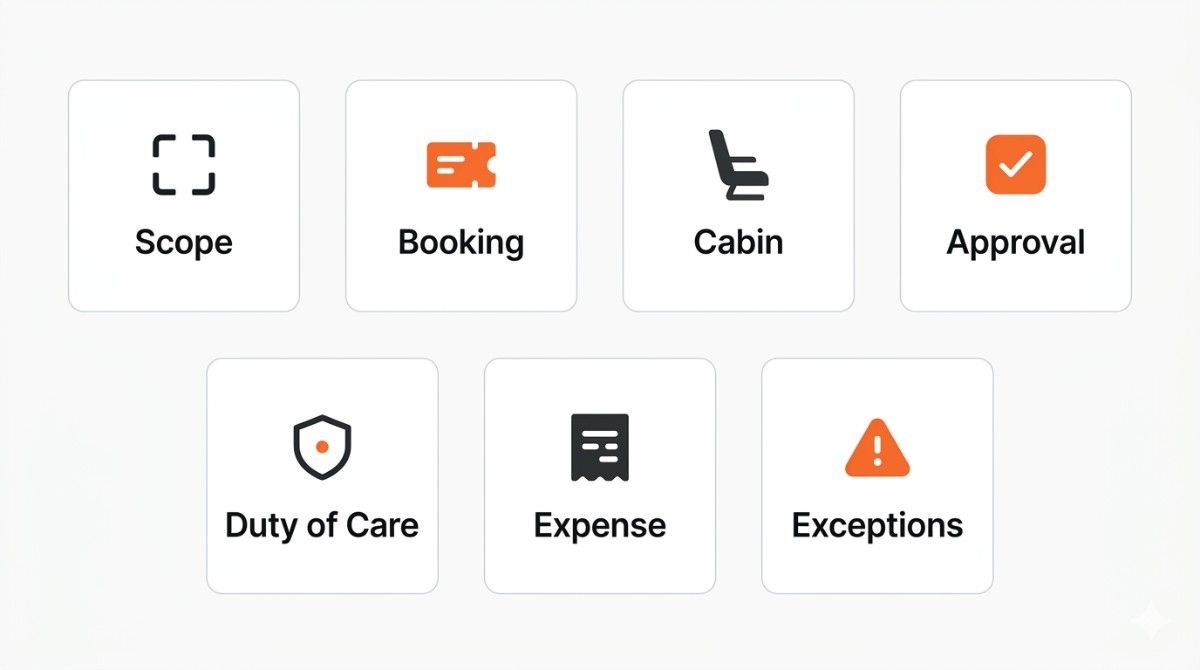
A complete executive travel policy covers seven areas. Missing any of them creates a predictable failure mode, usually around approvals or duty of care.
1. Scope and eligibility
Who the policy applies to: C-suite, VP-level leaders, board members, partner-track consultants with executive-equivalent travel needs. Be explicit about edge cases (executive spouses on client events, board-member travel reimbursement, candidate travel for executive recruiting).
2. Booking process and approved channels
There should be one approved booking channel for executive travel. Executives often book outside the corporate channel (personal assistants, direct airline/hotel loyalty accounts), which breaks compliance visibility and leaves finance guessing at spend. The policy should name the channel and the escalation path for exceptions.
3. Cabin class and lodging tiers
Typical executive allowances:
- Economy for flights under 3 to 4 hours
- Premium economy or business for flights over 4 to 6 hours
- Business class for international long-haul (8+ hours)
- Approved premium hotel tier with negotiated program rates
Be explicit about first-class. Most executive policies require CEO or board approval for first-class international, and many disallow it entirely. One of the prospects who was evaluating ITILITE and eventually became our customer flagged an important requirement:
Explicit rules prevent ad-hoc upgrades that become precedent.
4. Approval workflow (tier-based, not direct-manager)
The default Travel and Expense approval, where every expense routes to the employee’s direct manager, breaks for executive travel. The CEO has no manager. The CFO shouldn’t queue-review the CRO’s dinner expenses. Use role-based routing:
- VP and below: standard threshold routing
- SVP / C-level (non-CEO): CEO or CFO approval for out-of-policy; auto-approved within policy
- CEO: Board travel committee or audit committee review quarterly (batched, not per-expense)
Several of our customers have requested tiered approval structures specifically so executives don’t clog the standard approval queue, and so the C-suite’s compliance data is still auditable without daily CFO sign-off.
5. Duty of care and safety protocols
Executive travel has heightened duty-of-care obligations. The policy should cover:
- 24/7 traveler support with a named emergency contact
- Traveler tracking for international and high-risk destinations
- Pre-trip safety briefings for high-risk regions (include health risks, political stability, civil unrest, weather)
- Travel insurance covering medical evacuation, emergency health, trip cancellation, and lost luggage
- Group executive concentration rules (see next section)
Mark Larsen, NBAA Director of Safety and Flight Operations, has put the stakes plainly: “The loss of top executives will likely be more detrimental to a smaller organization than to a large company, even placing its continued existence in jeopardy.” Duty of care isn’t ornamental.
6. Expense reporting and reimbursement
Shorter reimbursement cycle for executives (most programs target 5-7 business days), direct deposit, receipt requirements calibrated to executive spend (expect client entertainment above standard receipt thresholds, so require business-purpose documentation on any client meal above $100). Automatic corporate card integration removes most of the manual receipt burden.
7. Exception handling
Executive travel is where exceptions happen: last-minute customer visits, stranded travelers, medical emergencies, and high-stakes negotiations requiring unusual flexibility. The policy should define a clean exception workflow: written justification at the point of booking, route to a named super-approver, log for quarterly review. Without a named exception path, executives route around the policy, and you lose both the control and the audit trail.
How should you handle group executive travel?
This is where most executive travel policies are weakest and where the consequences of a mistake are most severe.
Group executive travel concentration is the practice of limiting how many key executives can fly on the same aircraft or travel on the same route together. The rationale is business continuity: a single-point-of-failure event (a crash, a weather diversion, a security incident) that takes out multiple executives at once can cripple a company, especially a smaller one with a concentrated leadership team.
A practical group executive travel rule:
- No more than 2 C-level executives on the same commercial flight
- No more than 3 VP-or-above leaders on the same commercial flight
- Joint CEO/CFO travel requires explicit board committee approval
Enforcing this is straightforward in a centralized booking tool (the system flags bookings that violate the rule and routes to a pre-clearance approver). Enforcing it when executives book directly is nearly impossible, which is another reason to consolidate executive booking into the corporate travel channel.
How ITILITE turns executive travel policy into an enforced workflow
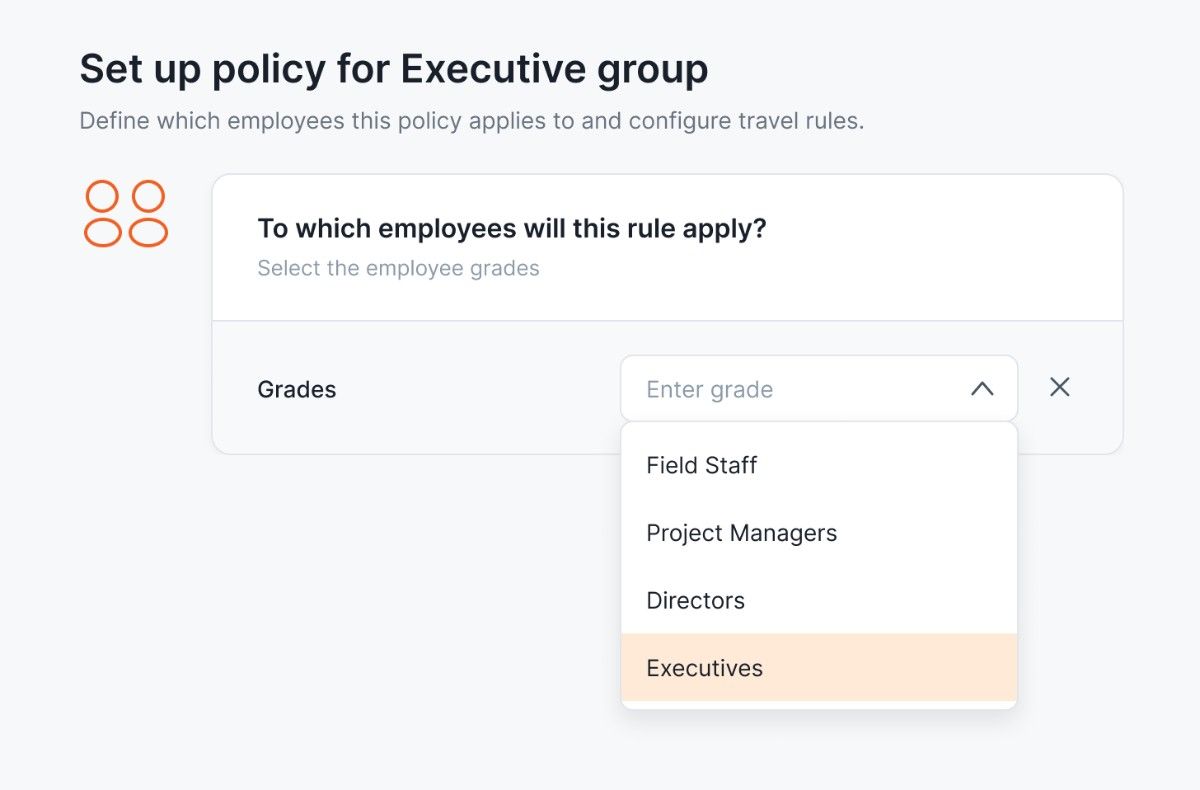
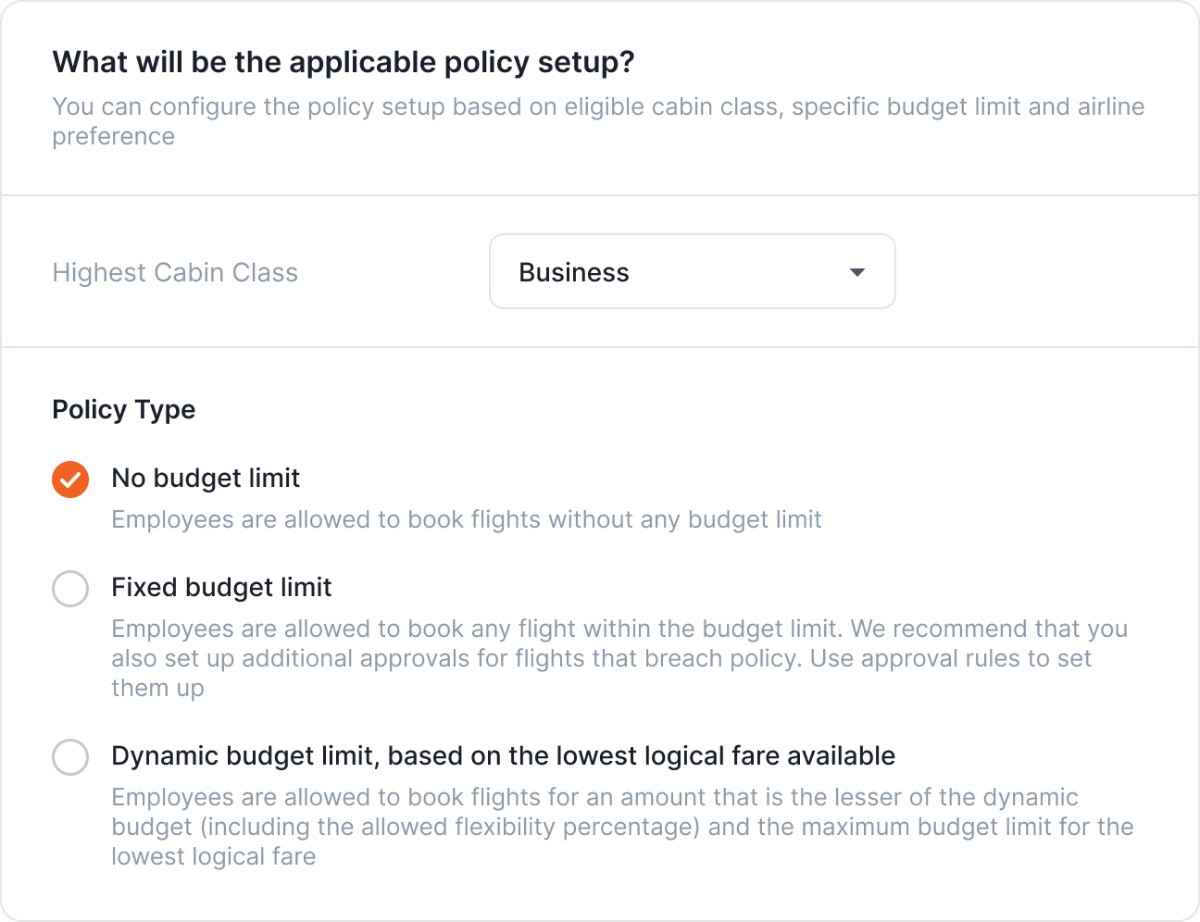
Most of the policy fixes above only work if the platform can enforce them at booking time, not in a quarterly audit. ITILITE is built to apply executive-tier rules as the booking happens, then keep the data clean for compliance review afterward.
On the policy and approval side:
- Travel policies are checked at the moment of booking. Out-of-policy options are blocked or flagged before confirmation, not caught after the trip.
- Cabin class, hotel nightly caps, and approval flows are configurable per employee level. Executive tiers and standard tiers carry different rules in the same workflow.
- Approval chains support multiple sequential approvers, configurable by department, spend threshold, or trip type. Itinerary-level and option-level approvals are both available, so a CEO trip can route differently from a VP trip.
- Approval notifications can route by project code or cost center, useful for board-level travel reimbursed against committee budgets.
On the duty-of-care and visibility side:
- Every traveling executive shows up on a single live screen, updated in real time based on the active itinerary. During disruptions (weather, civil unrest, medical), an admin or EA can answer "where is the CFO tonight?" in seconds.
- 24/7 human support connects in under 60 seconds via chat or phone, available directly to the executive rather than just to the EA. A stranded executive can call the platform themselves.
- A central booker (EA, travel coordinator) can book for any executive from their own account using the Book-for-Others feature, with confirmations routed to both the booker and the executive.
The combined effect: executive travel rules stop being aspirational and start being a workflow the platform runs against. The written policy still matters, but it is the configuration, not the enforcement layer.
See how ITILITE handles executive travel policies and approvals


How does a strong executive travel policy impact retention and recruitment?
Executive travel isn’t just a cost center, it’s a signal of how the company treats its leaders, and that signal shows up in retention numbers.
A Deloitte research states that 82% of C-suite executives are more likely to stay with companies that actively support their well-being. Travel program quality which covers how responsive support is, how flexible the policy is, how little friction travel adds to already-packed schedules, is one of the most visible pieces of “leadership well-being” there is.
At the same time, executive turnover is rising: Vestd reports CEO departures climbed 16% year-over-year in 2024. A travel policy that feels punitive or bureaucratic becomes one more reason a frustrated executive looks elsewhere. Conversely, a policy that shows up as a 5-minute booking with a refundable fare, a familiar hotel, and 24/7 support signals a company that respects the executive’s time.
The policy also matters for recruiting. Executive candidates, especially ones joining from companies with polished travel programs, notice immediately when they land in a role with a clunky, restrictive, or support-poor travel experience. First impressions on travel experience are second only to first impressions on compensation and leadership fit.
What are the most common executive travel policy mistakes?
Six failure modes consistently show up in executive travel programs that aren’t working:
1. Vague or unwritten guidelines
The first mistake is not having a clear policy at all. Without written rules, executives make individual decisions that may conflict with each other, company norms, or tax compliance expectations. Vague policies (“reasonable and necessary business travel”) are only marginally better; ambiguity creates friction at approval time.
2. Ignoring executive preferences
A policy that rigidly dictates airline or hotel choice without accommodating individual executive preferences creates friction without value. Document preferred carriers, hotel brands, and amenity requirements (healthy breakfast, gym access, specific loyalty programs) and let the booking flow match them, within policy tier. Ignoring preferences doesn’t save money; it causes executives to book outside the system.
3. Weak duty of care
Missing or boilerplate duty-of-care language. Executive travel without clear 24/7 support, emergency protocols, and traveler tracking is a legal and operational risk, and it’s the specific piece NBAA flags as most underdeveloped in private-company policies.
4. No cost control
The opposite mistake: letting executives book whatever they want because “they’re executives.” Even CEOs should have documented caps (first-class approval gate, premium hotel tier limit, refundable-fare rules). Unlimited discretion creates both budget risk and optics risk. The best CFO-level programs have tight caps with broad exception paths, not the reverse.
5. Over-strict rigidity
The opposite of #4: policies so tight they force executives to violate them for legitimate business reasons. If your policy requires 14-day advance booking for all flights, you’ve just mandated rule-breaking for every last-minute customer visit. Build flexibility and exception workflows into the policy; don’t force executives to work around it.
6. Ignoring cultural sensitivity in international travel
Executives traveling internationally for high-stakes meetings need cultural context: meeting etiquette, dress codes, gift-giving norms, business-hours expectations. A handshake norm that works in Chicago doesn’t work in Tokyo or Riyadh. Include destination-specific cultural briefings in the policy, particularly for executives attending M&A meetings, regulatory engagements, or board-level partner negotiations.
FAQ
What’s the difference between an executive travel policy and a regular corporate travel policy?
An executive travel policy builds on the corporate travel policy with executive-specific rules: more permissive cabin and lodging tiers, role-based approval routing (not direct-manager), heightened duty-of-care requirements, group-executive concentration limits, and explicit exception workflows. Most companies layer the executive policy over the standard one rather than replacing it.
Does our company really need a separate executive travel policy?
If you have a C-suite that travels more than a few times a year, yes. The default approval routing in standard T&E tools doesn’t work for executives (direct-manager breaks at the CEO level), and the duty-of-care and group-travel concerns don’t apply meaningfully to standard employees.
Who should approve executive travel expenses?
Use role-based routing: VPs and below go through standard threshold routing; SVPs and C-suite (non-CEO) get auto-approved within policy with CFO/CEO review on out-of-policy; CEO travel is reviewed quarterly by the board travel or audit committee rather than per-expense. Avoid routing executive expenses to the default direct-manager, it creates friction and doesn’t scale.
How much flexibility should executives have on cabin class and hotel tier?
Most policies allow premium economy or business class on flights over 4-6 hours and business class on international long-haul, with first-class requiring explicit CEO/board approval. Hotel tiers should match the executive cohort’s travel load: an executive traveling weekly needs a hotel tier that supports sustainable work, not just the lowest-rate rule. Rigid low-tier rules create the exact executive-retention friction described above.
What should the executive travel policy say about duty of care?
At minimum: 24/7 support with a named emergency contact, traveler tracking for international and high-risk destinations, pre-trip safety briefings for high-risk regions, travel insurance covering medical evacuation, and a group-executive concentration rule. If your policy doesn’t mention at least these five, it’s materially incomplete.
How often should the executive travel policy be updated?
Annually at minimum. Interim updates should trigger any time the company goes through a leadership change, expands into a new region, experiences an incident that exposed a gap, or sees regulatory or insurance requirements shift (D&O insurers sometimes push updates to group-executive concentration rules).
Can a small private company run an effective executive travel policy without enterprise tooling?
Yes. A small private company’s executive travel policy can be a one-page document: cabin tier rules, approved booking channel, one-line exception workflow, 24/7 support phone number, annual review cadence. The sophistication scales with headcount and travel volume. What matters is that the policy exists, is written down, and is updated; not that it’s long.

Vishal Jetley is Director of Marketing at ITILITE, where he writes about business travel, expense management, and corporate cards. Before ITILITE, he worked at HighRadius, helping scale finance-focused SaaS products for enterprise teams. His work focuses on travel operations, spend control, and modern finance workflows.
Control Costs, streamline travel with 24/7 support.
A fully integrated corporate travel management software that dramatically reduces spends while improving user experience




.jpeg)

%20(1).png)
%20(1).png)





.jpeg)


.jpeg)
.jpeg)

.webp)
.jpeg)

.webp)









.png)