

Travel and Expense Policy Best Practices: 10 Tactics That Actually Get Enforced (2026)
.jpeg)


TLDR;
- The biggest travel and expense policy mistake isn't policy design, it's how approvals are set up. When managers have to review every line of every expense report, they start approving without reading, and the policy stops being followed..
- We reviewed 2,000+ conversations with finance, HR, and operations leaders. 85% said their T&E policy isn't working, and almost all of them pointed to enforcement as the problem, not the policy itself.
- Companies using automated T&E software spend 27% less time than companies running manual policies, per Runzheimer International.
- Modern programs target a 7-day reimbursement cycle. Legacy 21-day cycles drive employee float anxiety and delay submissions, hurting real-time compliance visibility.
- Best practice isn't a fixed list. Review it annually, and refresh sooner whenever GSA per diem rates, tax rules, or company structure change materially.


Why travel and expense policy best practices matter in 2026
Travel expense (T&E) is one of the largest controllable costs for most companies, and one of the easiest to leak.
Business travel spend in the U.S. (domestic) will reach $318 billion in 2026, according to the Business Travel News.
At that scale, even a 3% leakage rate becomes a material hit to the P&L.
A good T&E policy isn't a document you write once and file. It's a workflow you enforce continuously, refresh annually, and design around how employees actually behave (rather than how a compliance officer wishes they behaved). The ten best practices below focus on tactics that get enforced in practice, not just documented on paper.
One framing shift to keep in mind: the "best practice" isn't always a rule. Sometimes it's a design choice about how the rule shows up in the employee's day, in a booking screen, an approval queue, or a receipt upload. That distinction is what separates policies people follow from policies people work around.
1. Write clear, scannable policy guidelines
A good travel and expense policy controls costs, protects the company legally, and tells employees what they can and cannot do before they're in the middle of a trip. Most policies fail not because they're missing rules, but because nobody can find the rule they need in 30 seconds. Scannability is the design goal.
At minimum, the policy should cover:
- Reimbursable categories. Airfare, lodging, ground transport, meals, conference fees, client entertainment, and so on. List non-reimbursables explicitly to avoid grey areas.
- Documentation rules. Receipt thresholds, submission deadlines, per-expense context requirements (especially for client entertainment and gifts).
- Pre-approval triggers. International travel, expenses above a set threshold, first-class or business-class flights.
- Spending caps. Meal per diem by city, lodging caps, mileage reimbursement rates, and mileage.
- Submission deadlines. Most modern programs use 30 days. A few use 60.
In short, write it in plain language. If an employee needs to re-read a paragraph to understand the rule, the rule is too long. A good test: hand the draft to someone outside finance and ask them to find the rule on lodging caps in under 60 seconds. If they can't, restructure.
If you're starting from scratch, our business expense policy template covers each of these categories with editable starting language.
2. Use tiered per diem rates, not a flat cap
A single $50/day meal cap punishes employees in New York and overpays employees in rural counties. Both patterns create resentment, and both invite policy workarounds. Tiered per diems fix this by tying the daily allowance to the cost of being in a specific place.
Three approaches work in practice:
- Flat per diem. Simplest option, fine for a small team that travels to a consistent mix of cities.
- GSA-based. Location-specific, updated annually by the U.S. General Services Administration. The default choice for U.S.-centric programs. See current GSA per diem rates.
- Custom tiered. By city tier or country, plus separate caps for incidentals and airport transfers. Best for global teams.
Per diems also simplify finance operations. There's no receipt-matching for routine meals, the standard is defensible during audits, and budgeting becomes more predictable. The trade-off is annual upkeep. GSA rates change every October, so build the refresh into your finance calendar rather than discovering the gap after the fact.
In our experience, the most common per diem mistake isn't picking the wrong tier, it's failing to publish the table in a place employees can find without asking finance. If the rate lookup requires a Slack message, the rate effectively doesn't exist.
3. Design approvals around manager time
This is the single highest-impact best practice on the list, and it's the one most companies get wrong.
Default T&E tools route every expense to the direct manager. Managers with 10 reports who travel frequently end up reviewing hundreds of line items each month. After a while, they stop reading and just hit approve..
One finance director described their current state bluntly:
"Getting really tired of reviewing huge expense reports." Another civil-engineering finance lead said it more plainly: "Some of the managers will just be like approved, just let it go."
The fix is threshold-based routing, like the following:
- Under $100: auto-approved if in policy
- $100 to $500: direct manager
- Above $500: finance director or VP
- Out-of-policy at any amount: written justification, routed to a designated approver
Threshold routing accomplishes two things at once. First, it reduces the approval volume managers see, so they can actually review the expenses that matter. Second, it creates a paper trail of why out-of-policy expenses were allowed, which is the audit trail finance teams need.
If you're designing the routing rules from scratch, our walkthrough on building an expense approval workflow covers six common patterns and where each one fits.
Critically, the same logic should apply to pre-approval. Requiring sign-off on every $40 client lunch floods the approval queue, and managers stop reading carefully. Pre-approval should fire on the cases where it changes behavior: international travel, capped flight classes, and any expense above a meaningful dollar threshold.
4. Automate policy enforcement at the point of booking
The old model (policy in a PDF, employees book freely, finance catches violations later) doesn't scale. It creates friction after the fact, when the money is already gone and the traveler has already flown.
Modern programs embed policy rules into the booking flow itself. Travelers see only compliant flights and hotels in the search UI. Out-of-policy options are either hidden, flagged with a required justification, or routed to an approver before the booking confirms. Platforms like ITILITE work this way: policy logic lives inside the booking and expense flow, not in a travel and expense policy document employees read once at onboarding and never reopen.
According to a Runzheimer International study, companies using automated T&E software spend 27% less on average than companies running manual policy enforcement.
The savings come from three places: fewer out-of-policy bookings, less time negotiating exceptions, and near-zero leakage on categories that used to be manual (such as hotel ancillaries and seat upgrades).
There's a behavioral angle here too. When the booking flow itself nudges travelers toward compliant options, employees stop perceiving policy as a punishment after the trip. It becomes the path of least resistance during the trip. That shift in perception matters more than any one rule.
5. Standardize trip reports and documentation
Trip reports and expense submissions should capture a consistent set of fields across every traveler:
- Dates and locations of travel
- Itemized expense list with receipts
- Purpose and business outcome (especially for client entertainment)
- Job or project code, if applicable
- Any pre-approvals referenced
Standardizing the format does two things. First, it gives finance teams clean data to aggregate and audit. Second, it forces travelers to think critically about the business purpose of each trip before the expense lands. Teams that submit ad-hoc, free-text reports tend to over-spend on "nice to have" add-ons. Teams using a structured submission format don't.
Receipts above a threshold (commonly $25 to $75) should be required. Below that, trust the employee and audit a random sample. That's faster and cheaper than demanding a receipt for every $4 coffee. The threshold is itself a policy choice, and worth revisiting once a year as small-purchase prices drift
6. Modernize reimbursement cycles and payment methods
If your program still uses a 21-day reimbursement cycle (the modal benchmark we see in companies running legacy processes), you're forcing employees to float business expenses on personal credit cards for three weeks. That creates three downstream problems:
- Delayed expense submission: Employees wait until multiple trips accumulate before submitting, which kills real-time compliance visibility.
- Morale drag: Especially for junior employees with tight personal cash flow.
- Error amplification: Weeks-old receipts go missing, business purpose fades from memory, reconciliation takes longer.
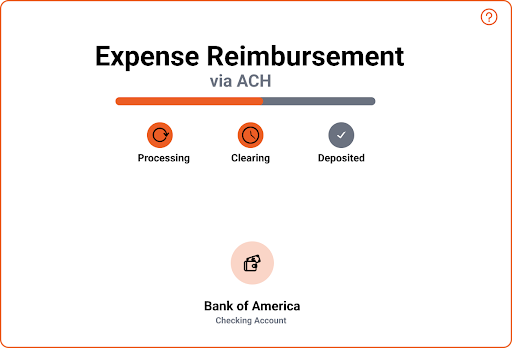
The modern target is 7 business days from approval to deposit, via direct deposit or ACH. International employees (particularly in Canada, Europe, and LATAM) need extra attention. Many legacy platforms drop non-U.S. bank transfers into a manual workaround loop that generates endless failure notifications.
Corporate cards paired with an automatic feed into the expense management software further reduce reimbursement volume. The spend shows up automatically, and the traveler just confirms the business purpose. That single change tends to cut reimbursement-driven submissions by half within a quarter.
7. Centralize the Travel and expense (T&E) process
One finance director described the legacy pattern:
"Download from [TMC], upload to [expense tool], download from [expense tool], upload to payroll system, download from payroll, upload to accounting system. Not a single API, no integration between them."
Six manual handoffs, each one a point of data loss or error.
A centralized T&E stack consolidates booking, expense submission, card management, and accounting integration into one flow. Even if you don't adopt an all-in-one travel management software, the best practice is to minimize the number of manual handoffs. Map the current path of a typical trip's data from booking to GL posting, and aim to cut the number of hops in half.
There's a measurement angle here too. Multiple tools make it nearly impossible to answer basic compliance questions, such as "what percentage of bookings happened outside our preferred channel last quarter?" Centralization isn't just about efficiency. It's about making the data legible enough to act on.
Create and enforce policies effortlessly


8. Build duty of care into the policy
Duty of care is the company's responsibility to look out for employee safety while they're traveling on company business. In 2026 this typically includes:
- Traveler location visibility during active trips, especially for travelers in unfamiliar regions
- 24/7 support access for stranded, ill, or safety-compromised travelers
- Emergency communication protocols defined in the policy, not invented in the moment
- Risk alerts integrated into the booking flow (weather disruptions, political incidents, regional advisories)
Duty of care isn't only ethically important. It's legally material for U.S. companies subject to OSHA's general duty clause, and for anyone operating internationally where traveler safety incidents can trigger specific regulatory obligations. If your current policy doesn't address it, add it before the next traveler is stranded at an airport over a holiday weekend.
The practical test: if a traveler is in a city with an active disruption right now, can your travel manager pull a list of who's there in under five minutes? If no, the duty-of-care side of the policy is a gap, regardless of how well-written the cost-control side is.
9. Audit policy compliance and act on the data
Writing a policy is a one-time effort. Keeping it working is a continuous one. Four signals are worth tracking monthly:
- Out-of-policy submission rate (%). Overall and by category.
- Average reimbursement cycle time. Target 7 days, flag anything over 14.
- Exception request volume. Rising volume means either the rules are too tight or the exception process is easier than the main path.
- Top 5 spend categories vs. prior quarter. Identify drift early.
Use audit findings to tighten specific rules, loosen unrealistic ones, and identify training gaps. A best-practice policy isn't rigid. It gets revised every 12 months minimum, and sooner when data shows a specific rule isn't landing.
The Association of Certified Fraud Examiners reports expense-reimbursement schemes cost companies an average of $251,000 per incident and go undetected for 18 months.
That's exactly the time horizon you're blind across if you only audit the policy annually.
10. Roll out changes with explicit change management
Most policy updates fail at the rollout, not the drafting.
One oil-and-energy HR lead described a previous attempt at their company:
"Folks push back. They just think this is very restrictive. It just slows down the adoption." Another finance leader told us they'd shelved a planned update entirely because too much time had passed since they first scoped it.
Three moves separate sticky rollouts from failed ones:
- Announce before go-live, not the morning of. Give affected employees a 30 to 60 day window to adjust expectations.
- Train approvers separately from travelers. Approvers are the new policy's frontline, and they need to know the routing rules and exception workflow before the first policy-update submission lands.
- Explain the why, not just the what. A policy that cuts per-meal caps from $80 to $65 lands differently if employees understand it ties to a specific budget target the whole team contributes to.
Worth noting: change-management cost is real, and it scales with headcount. Budget at least a quarter for any non-trivial T&E policy revision in a 500+ person company.
How travel and expense policy best practices differ by company size
Most articles on this topic treat every company the same way. In practice, a 20-person seed-stage startup and a 2,000-person enterprise face almost nothing in common except the word "policy." Tailoring best practices to size is itself a best practice.
The single best practice that applies at every size: match policy complexity to headcount and travel volume. A 10-person team forced to use enterprise-grade approval routing gets slow. A 2,000-person company running on a one-page policy gets leaky.
What KPIs should you track to measure T&E policy success?
The fastest way to tell whether your travel and expense policy is working is to track a small set of operational KPIs and review them on a fixed cadence. The list below is what we see most consistently across mature programs:
Treat these as a dashboard, not a one-time report. The compounding effect of reviewing them monthly is what shifts a policy from "documented" to "actually enforced."
Common T&E policy mistakes to avoid
Seven failure modes show up consistently across the finance teams we work with:
- Rules so tight that employees find workarounds: Absolute bans on above-economy long-haul flights tend to get ignored, not obeyed.
- Managers approving without reading: The number-one enforcement failure, fixed with threshold-based routing.
- Policy as PDF, not workflow: A policy employees never touch except during onboarding effectively doesn't exist.
- Static per diem across regions: A single global cap punishes or overpays depending on the city.
- Never updating reimbursement SLAs: Without a published target, cycles slowly extend from 14 to 21 to 30 days.
- Skipping change management at rollout: Pushback kills adoption faster than any policy rule.
- Annual audit as the only review: Waiting 12 months to catch drift is how $250k fraud schemes mature undetected.
A practical heuristic: if a rule is being violated at scale, the rule is more likely wrong than the employees are. Investigate before you tighten.
FAQ
What are the most important travel and expense policy best practices?
In order of impact: (1) design approvals with threshold-based routing so managers don't blindly approve; (2) automate policy enforcement at the booking stage instead of reviewing after submission; (3) use tiered per diems instead of a flat cap; (4) target a 7-day reimbursement cycle; (5) roll out changes with explicit change management. Policy-writing itself is necessary, but it isn't the biggest lever.
How often should a travel and expense policy be reviewed?
At minimum once a year. Finance team should trigger interim reviews any time GSA per diem rates update, tax rules change, the company goes through M&A, travel volume shifts materially, or your audit data shows a sustained rise in out-of-policy submissions in a specific category.
How do you enforce a travel and expense policy when employees work around it?
The answer is almost never "more rules" or "stricter consequences." It's usually one of three design changes: move enforcement into the booking flow (so out-of-policy is hard to choose), simplify rules that employees violate because they don't understand them, or revisit the rule itself. If the majority of employees are violating a specific cap, the cap is probably wrong for current market rates.
Should every T&E expense require pre-approval?
No. Requiring pre-approval on every expense burns manager time and slows the business. Use threshold-based pre-approval: anything above a set amount (commonly $500) or any out-of-policy booking requires pre-approval. Routine spend within policy should not.
What should a modern reimbursement cycle look like?
Target 7 business days from approval to deposit, with direct deposit or ACH as the default payment method.
How much do automated T&E tools actually save?
Studies vary. Runzheimer International data shows companies using automated T&E software spend 27% less than companies running manual enforcement. Savings come from fewer out-of-policy bookings, reduced approval friction, and lower processing cost per expense report. Programs reporting the largest savings tend to be ones that automated booking and expense submission together, not just one of the two.
What KPIs should we track for travel and expense policy compliance?
Track six metrics monthly: policy compliance rate (target above 90%), average reimbursement cycle time (target 7 days), pre-trip approval rate, out-of-policy spend by category, exception approval rate, and cost per expense report. The list is short on purpose. A KPI you don't review monthly isn't a KPI, it's a slide.

Vishal Jetley is Director of Marketing at ITILITE, where he writes about business travel, expense management, and corporate cards. Before ITILITE, he worked at HighRadius, helping scale finance-focused SaaS products for enterprise teams. His work focuses on travel operations, spend control, and modern finance workflows.
Control Costs, streamline travel with 24/7 support.
A fully integrated corporate travel management software that dramatically reduces spends while improving user experience




.jpeg)

%20(1).png)
%20(1).png)





.jpeg)


.jpeg)
.jpeg)

.webp)
.jpeg)

.webp)









.png)