Best Corporate Credit Cards for Small Businesses in 2026: Traditional Bank Cards vs SaaS Cards Compared


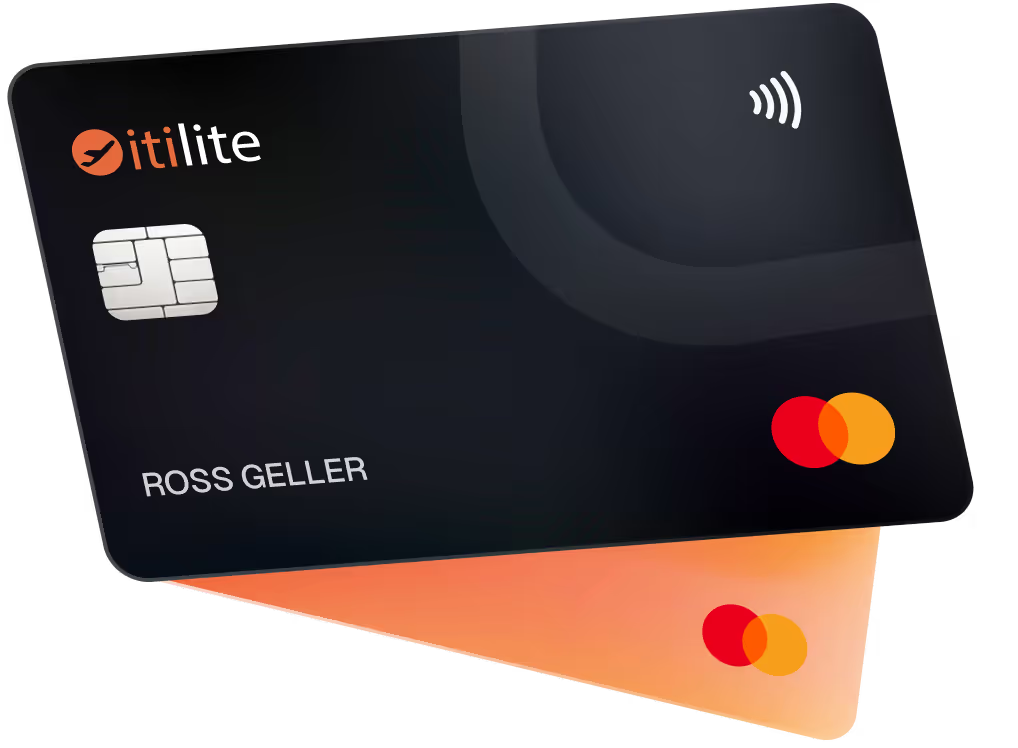

TLDR;
- SaaS corporate cards (ITILITE, Ramp, Brex, BILL Spend & Expense, Mercury IO) approve in minutes using cash-flow underwriting and typically waive personal guarantees for funded businesses
- Traditional bank cards (Chase Ink, Amex Blue Business, Capital One Spark, US Bank Business Triple Cash) underwrite on personal credit history and offer richer points-and-transfer rewards programs
- The biggest cost difference: SaaS cards are typically free (revenue comes from card interchange), while traditional cards charge annual fees between $0 and $375 in the SMB segment
- Personal guarantee is the deciding factor for many founders. Traditional cards almost always require it. SaaS cards from Ramp, Brex, and BILL waive it for businesses with strong cash flow or VC backing
- If you want travel, expense, and corporate cards on the same platform, a unified SaaS card wins. If you want maximum rewards on every dollar, a traditional card still wins


Two completely different categories of corporate credit cards now compete for small business spend. Traditional bank cards (Chase, Amex, Capital One, Citi, US Bank) underwrite personal credit history and reward you with points or cash back. SaaS corporate cards (ITILITE, Ramp, Brex, BILL Spend & Expense, Mercury IO) underwrite business cash flow and bundle the card with expense automation, virtual cards, and approval workflows.
This article ranks the 10 best small business corporate cards for 2026 across both categories with the trade-offs each one carries, so you can pick the category that fits before you pick the card.
SaaS or traditional? Traditional cards win on rewards depth, airline transfer partners, and the consumer-grade card features small business owners already know. SaaS cards win on instant approval (minutes vs days), no personal guarantee for funded businesses, built-in expense automation, and virtual cards for safer online and travel payments. The right pick depends on your business stage, spend mix, and whether you want a card alone or a card-plus-software bundle.
Top 10 corporate credit cards for small businesses at a glance
The matrix below groups the 10 cards into SaaS and traditional categories. Pick the category first, then narrow within it.
SaaS corporate cards (software-led, cash-flow underwriting):
| Card | Annual fee | Best for | Differentiator |
|---|---|---|---|
| ITILITE | $0 (per-trip pricing) | SMB wanting unified travel + expense + card | Single platform across travel, expense, and corporate cards |
| Ramp | Free (card-funded) | SMB cost reduction | 1.5% flat cashback plus spend insights and AP automation |
| Brex | Free (card-funded) | VC-backed startups | No personal guarantee for funded businesses, treasury and banking add-ons |
| BILL Spend & Expense (Divvy) | Free (card-funded) | AP-led teams | Pre-allocated budgets, real-time card controls |
| Mercury IO | $0 | Startups already on Mercury banking | Card embedded into Mercury banking stack |
Traditional bank credit cards (personal-credit underwriting):
| Card | Annual fee | Best for | Differentiator |
|---|---|---|---|
| Chase Ink Business Cash | $0 | SMB with office supplies + utilities spend | 5% cash back on office supplies, internet, cable, phone (up to $25K/year combined) |
| American Express Blue Business Plus | $0 | Flat 2x points everywhere | 2x Membership Rewards on first $50K/year, then 1x |
| Capital One Spark Cash Plus | $150 | Flat 2% cash back, no FX fee | Unlimited 2% cashback, no foreign transaction fees |
| Chase Ink Business Preferred | $95 | Travel and digital advertising | 3x points on travel, shipping, internet/cable/phone, and ads (up to $150K/year combined) |
| U.S. Bank Business Triple Cash | $0 | New cardholders needing intro APR | 3% on gas, office supplies, restaurants, cell phone; 0% intro APR for 15 billing cycles |
SaaS vs traditional small business cards: a 5-dimension comparison
The decision between a SaaS corporate card and a traditional bank credit card comes down to five concrete dimensions, not feature checklists.
- Underwriting model: Traditional cards (Chase, Amex, Capital One, US Bank) pull personal credit reports and underwrite based on the cardholder's FICO score and credit history. Approval can take days or weeks. SaaS cards (Ramp, Brex, BILL, ITILITE, Mercury IO) underwrite based on business cash flow, bank balance, or funding history. Approval is typically minutes. For new businesses with limited personal credit, SaaS cards are often the only path to a meaningful credit line.
- Personal guarantee: Traditional small business cards almost always require a personal guarantee, meaning the cardholder is personally on the hook if the business defaults. SaaS cards from Brex and Ramp explicitly waive the personal guarantee for businesses with sufficient bank balance or VC funding. Mercury IO and BILL Spend & Expense follow similar models. For founders separating personal and business finances, this is the single most important difference.
- Rewards: Traditional cards win here. The Amex Membership Rewards transfer ecosystem, Chase Ultimate Rewards points transfers, and rotating-category cashback structures of Chase Ink Cash give traditional cards depth that SaaS cards rarely match. SaaS cards typically offer flat 1.0% to 1.5% cashback with no point-transfer ecosystem.
- Expense management: Modern SaaS cards from platforms like ITILITE bundle the card with expense automation, receipt capture, GL coding, virtual card issuance, and approval workflows. Traditional cards require separate expense software (Expensify, Concur, or similar). The total cost of ownership comparison only makes sense once you factor in the software the traditional card setup needs alongside it.
- Speed of issuance and controls: SaaS cards issue virtual numbers in seconds and freeze in one click from an admin dashboard. Traditional card issuers offer similar capabilities now but typically through the bank's app, which means another tool to manage and weaker integration with company finance systems.
Category 1: SaaS Corporate Cards
1. ITILITE
ITILITE is a unified travel and expense platform that includes corporate cards as part of the bundle. The platform is built for small and mid-market businesses that want travel booking, expense reporting, and corporate cards on one interface instead of three separate vendors. ITILITE pricing is built around a flat $10 per-trip model with no setup fees and no per-user software fees, which makes it predictable for SMBs forecasting card and software spend together.
Key features
- Corporate cards issued instantly, both physical and virtual, with per-card spending controls
- Travel booking with managed inventory across 800+ airlines and 2M+ hotels on the same platform as the card
- Real-time expense capture and automated reconciliation from card swipes
- Native integrations with NetSuite, QuickBooks, Sage Intacct, and other ERPs
Best for: Small and mid-market businesses (10 to 1,000 employees) where travel is a meaningful part of spend and where the finance team wants to consolidate travel, expense, and card on one platform.
How it underwrites: Bank balance and business cash flow. No personal guarantee for businesses meeting the qualification floor. Approval typically inside 24 hours.
Pricing: $10 per trip, no setup fees, no integration fees, no charge for inactive users. Card issuance is included in the platform.
2. Ramp
Ramp is the most-cited SaaS corporate card on Reddit and the b2b finance press in 2026, with a $13B+ valuation and a 10-second average approval time according to the company's published figures. The product pairs a no-annual-fee corporate card with automated expense capture, bill pay, and spend analytics that surface savings opportunities (cancel unused subscriptions, switch software vendors, renegotiate vendor contracts).
Key features
- Category and vendor-specific spend controls on a no-fee corporate card
- Card transactions that auto-create expense reports without manual entry
- AP automation included alongside the card in one platform
- 1.5 percent flat cashback on every base-plan dollar of card spend
Best for: SMBs (20 to 500 employees) focused on cost reduction and operational efficiency. Sweet spot is post-revenue companies with stable monthly card spend.
How it underwrites: Bank balance. Ramp typically requires a minimum bank balance (currently $25,000) to qualify. No personal guarantee for businesses meeting the threshold.
Pricing: Base Ramp plan is free. Ramp Plus is $15 per user per month and adds advanced approval workflows and procurement features. Source: Ramp pricing. A founder of a 35-person SaaS company told us, "We switched from a personal-guarantee Chase card to Ramp the week our seed round closed. The PG removal alone was worth it."
3. Brex
Brex is the corporate card built for venture-backed startups. The product launched with the explicit pitch that VC-backed founders shouldn't have to use personal credit to fund company spend, and the underwriting model reflects that: limits are calculated from cash on hand, runway, and funding history rather than personal FICO. Brex serves more than 30,000 companies and reports billions in card volume annually (https://www.brex.com/about).
Key features
- No-PG corporate cards for businesses qualifying on cash position and funding history
- Per-employee, per-department, and per-vendor spending limits
- Expense reports generated automatically from card activity
- Treasury services and cash management for excess runway via Brex Business Account
Best for: VC-backed startups, early-stage technology companies, and growing businesses with meaningful capital on hand. Brex is less suited to bootstrapped or revenue-only businesses, where Ramp or a traditional card may underwrite better.
How it underwrites: Cash on hand and funding history. Brex Essentials is free and underwritten on cash position. No personal guarantee for qualifying companies.
Pricing: Brex Essentials free for qualifying companies. Brex Premium is $12 per user per month for advanced features.
4. BILL Spend & Expense (formerly Divvy)
BILL Spend & Expense is the corporate card and expense module inside the broader BILL accounts-payable platform. The card is free, funded by interchange, and built around pre-allocated budgets, meaning employees can only spend what's been assigned to them rather than spending freely and getting approved after the fact. This is the strongest fit for AP-led finance teams already running BILL for invoice processing.
Key features
- No-fee corporate cards with pre-allocated budget controls
- Live expense data captured the moment a card transacts
- Native connection to the broader BILL AP and Cash Flow products
- Budget pools configurable by department, project, or one-off event
Best for: Small businesses with an AP-heavy spend profile (vendor invoices, recurring software, contractor payments) where BILL is already in the stack or about to be added.
How it underwrites: Bank balance. No personal guarantee required for qualifying businesses.
Pricing: Free, funded by interchange. The broader BILL AP product is priced separately.
5. Mercury IO
Mercury IO is the corporate card from Mercury, the banking platform that became the default fintech bank for VC-backed startups after Silicon Valley Bank's 2023 collapse. The card is embedded into Mercury's banking stack, which means transactions, controls, and reconciliation all happen alongside the operating account rather than in a separate card portal.
Key features
- Corporate credit and debit cards tied to Mercury banking
- 1.5% cashback on all card spend
- Per-card spending controls and instant freeze
- Integration with QuickBooks, Xero, and other accounting tools
Best for: Startups already banking with Mercury who want their card to live inside the same platform as their operating account. Mercury IO is less compelling as a standalone product if you're not already using Mercury banking.
How it underwrites: Mercury account balance. Mercury IO is essentially a credit line layered on top of an existing Mercury banking relationship.
Pricing: No annual fee. Mercury banking is free for most account tiers.
Category 2: Traditional Bank Credit Cards
6. Chase Ink Business Cash
Chase Ink Business Cash is one of the most-recommended no-annual-fee small business cards because of its category-based cashback structure. The card pays 5% cash back on the first $25,000 spent each year in combined purchases at office supply stores and on internet, cable, and phone services, then 1% after the cap and on all other purchases
Key features
- 5% cash back at office supply stores and on internet, cable, and phone services (up to $25,000 combined/year)
- 2% cash back at gas stations and restaurants (up to $25,000 combined/year)
- 1% cash back on all other purchases
- Free employee cards with individual spend controls
Best for: Small businesses with meaningful office supply and utility spend. The $25,000 category cap is the constraint to watch; businesses spending well above that will outgrow the headline rate.
How it underwrites: Personal credit history (typical requirement: FICO 690+). Personal guarantee required.
Pricing: $0 annual fee. 0% intro APR on purchases for 12 months, then variable APR.
7. American Express Blue Business Plus
/image
American Express Blue Business Plus is the simplest no-annual-fee Amex small business card, paying 2x Membership Rewards points on the first $50,000 in purchases each year, then 1x after the cap. Membership Rewards points transfer to airline and hotel partners at variable ratios, which is the depth Amex offers that flat-cashback cards don't match.
Key features
- 2x Membership Rewards points on first $50,000/year, then 1x
- No annual fee
- Free employee cards
- Membership Rewards point transfers to 20+ airline and hotel partners
Best for: Small businesses that want point flexibility (especially for travel redemptions) without paying an annual fee. The 2x rate isn't the highest available, but the transfer partner ecosystem is worth more to travel-heavy businesses than a flat cashback card.
How it underwrites: Personal credit history (typical requirement: FICO 700+). Personal guarantee required.
Pricing: $0 annual fee. Variable APR after 12-month intro 0% on purchases.
8. Capital One Spark Cash Plus
Capital One Spark Cash Plus is the flat-rate cashback option in the SMB segment, paying unlimited 2% cash back on every purchase with no category caps or rotating bonus categories. The card also has no foreign transaction fees, which makes it a strong pick for small businesses with overseas vendors or international travel.
Key features
- Unlimited 2% cash back on all purchases
- No foreign transaction fees
- Free employee cards
- $1,200 cash bonus after spending $30,000 in first 3 months
Best for: Small businesses with diverse spend that doesn't concentrate in one bonus category, especially those with international vendor payments or business travel abroad.
How it underwrites: Personal credit history (typical requirement: FICO 720+ for charge card). Personal guarantee required. Note: Spark Cash Plus is a charge card, meaning balances must be paid in full each month.
Pricing: $150 annual fee.
9. Chase Ink Business Preferred
Chase Ink Business Preferred is the travel-and-marketing card in the Chase Ink family. The card pays 3x points on travel, shipping purchases, internet/cable/phone services, and online advertising (Facebook, Google, Microsoft) on the first $150,000 combined each year. Points transfer 1:1 to Chase Ultimate Rewards partners including United, Southwest, and Hyatt.
Key features
- 3x points on travel, shipping, internet/cable/phone, and advertising (up to $150,000/year combined)
- 1x points on everything else
- Ultimate Rewards point transfers to 14 airline and hotel partners
- $750 cash equivalent welcome bonus after spending $8,000 in first 3 months
Best for: Small businesses where travel, digital advertising, and shipping are meaningful spend categories. The $150,000 cap is high enough that most SMBs won't hit it.
How it underwrites: Personal credit history (typical requirement: FICO 700+). Personal guarantee required.
Pricing: $95 annual fee.
10. US Bank Business Triple Cash
US Bank Business Triple Cash is the newer-cardholder option in the no-annual-fee segment, paying 3% cash back on gas, office supplies, restaurants, and cell phone services, plus a 0% intro APR for 15 billing cycles. The intro APR window is the longest among the major small business cards and matters for SMBs managing cash flow on equipment purchases or large one-time orders.
Key features
- 3% cash back on gas, EV charging, office supplies, restaurants, and cell phone services
- 1% cash back on all other purchases
- 0% intro APR for 15 billing cycles on purchases
- Free employee cards
Best for: Small businesses that need a 0% intro APR window for a planned large purchase, or SMBs with substantial recurring spend in the 3% categories (gas, office, restaurants).
How it underwrites: Personal credit history (typical requirement: FICO 690+). Personal guarantee required.
Pricing: $0 annual fee.
How to choose the right small business corporate card
Five questions cut through the marketing and point you at the right category and then the right card within it.
1. Do you want to put the founder's personal credit on the line?
If no, you're looking at SaaS cards (Ramp, Brex, BILL S&E, Mercury IO, ITILITE) where the personal guarantee is waived for qualifying businesses. If you're comfortable with PG, traditional cards open up.
2. Where does your spend concentrate?
If 60%+ of card spend is in one category (office supplies, travel, advertising), a category-bonus traditional card (Chase Ink Cash, Chase Ink Preferred) typically beats flat-rate options. If spend is diversified across many categories, a flat-rate card (Capital One Spark Cash Plus, Amex Blue Business Plus, Ramp 1.5%) typically wins on simplicity and total cashback.
3. Do you want the card plus the software, or just the card?
SaaS cards bundle expense automation, virtual cards, approval workflows, and (for ITILITE) travel booking. Traditional cards require separate software for these. If you'd otherwise be buying Expensify or Concur on top of a Chase card, a unified SaaS card removes the software line item. Buyers wanting a unified travel-expense-card platform should look at ITILITE; buyers wanting card-plus-AP automation should look at Ramp or BILL.
4. How fast do you need approval?
SaaS cards approve in minutes to hours. Traditional cards take days to weeks. For founders bootstrapping a launch or businesses that need a credit line tomorrow, SaaS is the faster path.
5. What's your spend volume?
Below ~$10K/month in card spend, the rewards on a traditional card likely net more dollars than a SaaS card's cashback even with the SaaS software value. Above ~$30K/month, the SaaS card's bundled software starts paying for itself even on the rewards-only comparison. Between those, it depends on your category mix.
FAQ
What is the difference between a corporate credit card and a small business credit card?
The terms are used interchangeably in 2026, but historically a "corporate" credit card meant a card issued to a business with an EIN and no personal guarantee (typically for larger enterprises), while a "small business" credit card was a card issued to a small business owner with a personal guarantee. SaaS cards from Ramp, Brex, BILL, ITILITE, and Mercury IO have blurred the line by offering no-PG cards to small businesses.
Can an LLC get a small business credit card?
Yes. LLCs can apply for both traditional bank credit cards (Chase Ink, Amex Blue Business, Capital One Spark) and SaaS corporate cards (Ramp, Brex, BILL Spend & Expense, ITILITE, Mercury IO). Traditional cards typically require the LLC owner to provide a personal guarantee. SaaS cards may waive the personal guarantee if the LLC meets the cash-flow or funding threshold.
Do small business credit cards require a personal guarantee?
Most do. Chase, Amex, Capital One, Citi, and US Bank small business cards all require a personal guarantee from the business owner. SaaS cards from Brex, Ramp, BILL Spend & Expense, ITILITE, and Mercury IO waive the personal guarantee for businesses with sufficient bank balance or funding history.
Are SaaS corporate cards better than traditional credit cards for small businesses?
It depends on the business. SaaS cards win on approval speed (minutes vs days), no personal guarantee for qualifying businesses, and built-in expense automation. Traditional cards win on rewards depth, point-transfer ecosystems, and the flexibility of carrying a balance with intro APR offers. Many small businesses run both, using a SaaS card for operating expenses and a traditional card for rewards-heavy categories.
Which small business credit card has the highest cash back?
In the no-annual-fee category, Chase Ink Business Cash pays 5% on the first $25,000 spent annually on office supplies and select utilities. Among flat-rate options, Capital One Spark Cash Plus pays unlimited 2% on all purchases. Among SaaS cards, Ramp pays 1.5% flat with the operational savings the platform surfaces on top.
How does the underwriting differ between Ramp/Brex and Chase/Amex for small businesses?
Ramp and Brex underwrite on business cash flow, bank balance, and funding history (for Brex, this means VC funding). Chase and Amex underwrite on the personal credit history of the business owner, typically requiring a FICO score of 690 or higher. The practical consequence: a new business with limited personal credit can often qualify for Ramp or Brex but not for Chase or Amex.

Ardra is a Content Strategy Manager at ITILITE with 6+ years of experience in travel and SaaS content. She holds a Master’s degree in Political Science from Lady Shri Ram College for Women and transitioned from academic research and travel content into SaaS content strategy.
She previously worked with JustWravel, where she focused on travel storytelling and digital content. Today, she specializes in SEO and AEO-driven content strategies that help businesses simplify complex travel and expense workflows into search-optimized narratives.
When she’s not working, Ardra is usually reading or watching films.
Control Costs, streamline travel with 24/7 support.
A fully integrated corporate travel management software that dramatically reduces spends while improving user experience


.avif)