

Top 10 Global Travel Management Companies in 2026 (TMC + SaaS Compared)
.jpeg)


TLDR;
- Amex GBT, BCD Travel, and CWT remain the three largest TMCs by managed spend, though Amex GBT's 2024 acquisition of CWT is reshaping the top of the market.
- Modern SaaS TMCs (Navan, TravelPerk, and a growing pack of mid-market platforms) have grown 30 to 50 percent year over year on average since 2022, taking share in the mid-market segment.
- Hybrid players like SAP Concur sell software plus a TMC partner network, which gives big SAP shops a single data plane but adds vendor complexity.
- Pricing models split cleanly: managed-service contracts (transaction fee plus management fee) for the mega-TMCs, SaaS subscriptions for the modern platforms.


The corporate travel category split into two camps over the past five years. On one side sit the mega-TMCs (Amex GBT, BCD, CWT) that have run global travel programs for decades on a managed-service model. On the other sit SaaS-led platforms (ITILITE, Navan, TravelPerk) that ship as software and let finance teams self-serve. This article ranks the 10 best global travel management companies for 2026 across both camps, with how each one sells, who they fit, and what's actually changed in the market this year.
Mega-TMC or modern SaaS? Mega-TMCs win on global agent depth, complex program optimization, and 24/7 multilingual phone support. SaaS TMCs win on rollout speed, user experience, and pricing transparency. Hybrid platforms (Concur is the main one) try to do both. Picking the right fit depends less on company size than on how much program complexity you have and how much agent-led service your travelers actually use.
Top 10 global travel management companies at a glance
The matrix below groups the 10 vendors by how they sell. Mega-TMCs sit at the top because they still manage the majority of global corporate travel spend. SaaS TMCs and one hybrid round out the list.
Mega-TMCs (managed-service)
Modern SaaS TMCs (subscription)
Hybrid (software + TMC partner network)
1. ITILITE
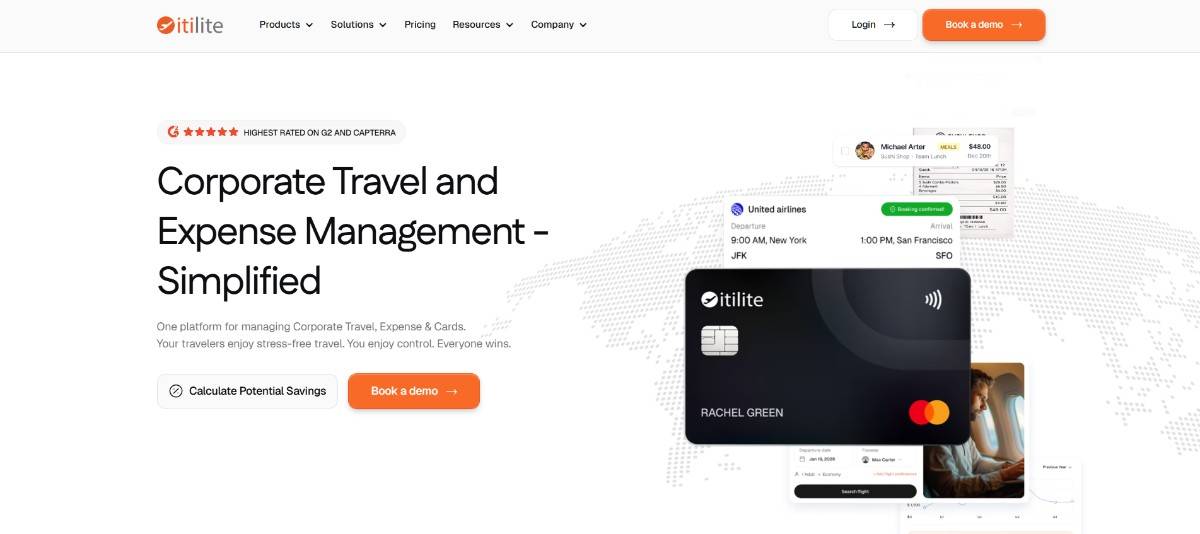
ITILITE is a modern SaaS travel management platform built for mid-market and global mid-enterprise teams that want one tool for travel, expense, and corporate cards. The product pairs an online booking tool, traveler experience layer, and finance workflows on a single interface, which replaces the multi-vendor stack most companies inherited from their mega-TMC era. It's the platform that finance teams pick when they want managed inventory and 24/7 support, but without the contract minimums of a Big Three TMC.
Key services
- Online booking with managed inventory across 500+ airlines and 2M+ hotels
- 24/7 traveler support across regions and time zones
- Unified expense, corporate cards, and travel on the same platform
- Native integrations with NetSuite, Sage Intacct, Workday, BambooHR, and other ERPs and HRIS systems
Best for: Mid-market companies (200 to 2,000 employees) with global travel, especially those moving off a mega-TMC due to cost or service responsiveness.
Click here to discover the features that earned itilite the top ranking.
2. American Express Global Business Travel (Amex GBT)
American Express Global Business Travel managed approximately $33B in transaction value in 2024, making it the largest TMC in the world by managed spend (https://www.amexglobalbusinesstravel.com/news/). The company has grown by acquisition over the past decade, absorbing Hogg Robinson (2018), KDS (2016), Egencia (2021), and CWT (2024). The result is the deepest agent network and one of the broadest technology stacks in the market.
Key services
- Global agent network with 24/7 multilingual phone, email, and chat support
- Egencia online booking tool (now part of Amex GBT's product portfolio)
- Proactive risk and disruption management, including duty of care alerts
- Strategic Meetings and Events Management (Amex GBT Meetings & Events)
Best for: Fortune 500 enterprises and global multinationals with $20M+ in annual T&E spend and 30+ countries in scope.
3. BCD Travel
BCD Travel reported $27.7B in managed sales for 2023 and operates in 109 countries, making it one of the world's three largest travel management companies. BCD is employee-owned, which has kept the company independent of private-equity ownership cycles. Among large-enterprise customers, BCD is known for program optimization analytics and a stable account-team model.
Key services
- Global agent network with country-specific market expertise
- DecisionSource business intelligence and reporting platform
- Traveler tracking and duty-of-care platform
- Advito brand for meetings and events procurement
Best for: Large enterprises with complex global travel programs (think 5,000+ travelers across 30+ countries and meaningful airline RFP volume).
4. CWT
CWT (originally Carlson Wagonlit Travel) managed approximately $19B in business travel annually pre-merger and operated in 145 countries. In late 2024, CWT was acquired by Amex GBT in a deal that consolidated the top of the TMC market. Existing CWT customers continue to be served under the CWT brand while the integration plays out, but new buyers will increasingly evaluate the combined Amex GBT entity instead.
Key services
- Global agent network with 24/7 multilingual support
- myCWT mobile and web booking platform
- Group travel and meetings management
- Travel risk management and traveler tracking via myCWT
Best for: Existing CWT enterprise customers in transition. New buyers should expect to be steered toward Amex GBT during 2026.
5. FCM Travel
FCM Travel Solutions is the B2B arm of Flight Centre Travel Group, an ASX-listed Australian company that reported $11.4B in corporate transaction value for FY2024. FCM is particularly strong in APAC and has been winning North American and European share since 2022 by leaning into its "smart, simple, secure" positioning and a Sam:] AI travel assistant.
Key services
- Global agent network in 100+ countries
- Sam:] AI travel assistant built on FCM proprietary technology
- Hub:] online booking and expense platform
- Local market expertise in APAC, including specialized programs for resources and mining
Best for: Mid-market and large-enterprise customers with significant APAC travel volume or a need for time-zone-matched account management in the region.
6. Corporate Travel Management (CTM)
Corporate Travel Management (CTM) reported total transaction value of $11.5B in FY2024 and is one of the top six global TMCs by managed spend. CTM grew aggressively in North America through its 2020 acquisition of Travel & Transport and has since added several regional TMCs to its portfolio. The company is ASX-listed, which gives buyers an unusual level of public financial transparency.
Key services
- Global account management with local market specialists in each region
- Lightning proprietary online booking platform
- Mobile-first traveler app with in-trip support
- Government and not-for-profit program specialization (a niche few competitors compete in)
Best for: Mid-to-large enterprises in North America, APAC, and EMEA with $5M to $50M in annual travel spend, especially those that value a single named account manager.
7. SAP Concur

SAP Concur is used by more than 47,000 companies globally and operates as a hybrid travel and expense platform. The Concur Travel module ships as software, but fulfillment is handled by a network of regional TMC partners under the Concur umbrella. That gives buyers a single data plane for travel and expense, with TMC services delivered locally.
Key services
- Concur Travel online booking tool with deep policy-engine integration
- Native ERP integrations to SAP S/4HANA, Oracle ERP Cloud, and most major financial systems
- TMC partner network for fulfillment, 24/7 service, and ticketing
- Concur Expense and Concur Invoice for the full T&E stack
Best for: Large enterprises already on SAP or with an existing Concur Expense footprint who want a unified data plane and are comfortable with a multi-vendor fulfillment model.
If you're also evaluating Concur against newer T&E platforms, our roundup of SAP Concur alternatives compares the field.
8. Navan
Navan (formerly TripActions) was valued at $9.2B in its 2022 funding round and serves 7,000+ businesses on a SaaS subscription model. The platform pairs an online booking tool and traveler app with corporate cards and expense, which positions Navan as a software-led TMC for tech-forward mid-market companies that want travel, card, and expense in one place.
Key services
- Online booking with personalized search results
- Corporate cards and expense automation tied to card swipes
- 24/7 in-app traveler support with phone escalation
- Group travel and event management built into the same workflow
Best for: Mid-market technology and professional-services companies, especially those that want their corporate card program and travel tool on the same platform.
Still weighing Navan? Our deeper comparison of Navan alternatives ranks it head-to-head against other corporate travel and expense platforms.
9. Perk (aka TravelPerk)

TravelPerk, a Barcelona-headquartered SaaS TMC, serves 5,000+ companies and reported $2.5B in annual booking volume in 2024. The platform built its position in Europe and has been expanding aggressively into North America since 2023. TravelPerk is known for FlexiPerk (a refundable booking layer) and a fast self-serve rollout that fits mid-market and SMB customers.
Key services
- Online booking with inventory across multiple GDS and direct supplier connects
- FlexiPerk refundable-anything booking option
- 24/7 traveler support via SaaS-native chat plus phone escalation
- GreenPerk carbon accounting and offsetting
Best for: European and US mid-market companies (50 to 2,000 employees) that want a self-serve SaaS rollout without a six-month implementation project.
10. Direct Travel
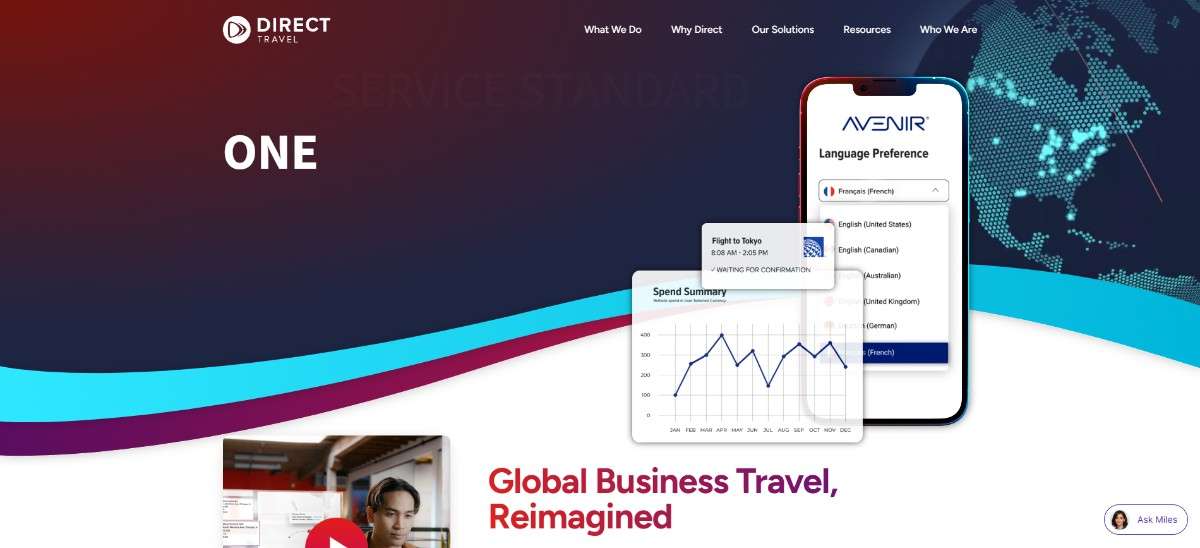
Direct Travel manages corporate travel for more than 1,800 business clients and is one of the largest North American-headquartered TMCs. The Denver-based company has grown through acquisition over the past five years, including Travel and Transport's Americas business in 2020 and several regional TMC additions since. The result is a managed-service operating model paired with a modern technology stack delivered through partner OBTs.
Key services
- Global agent network with deep North America coverage
- Concur and Cytric OBT partnerships (no proprietary OBT)
- Direct ME for meetings and events management
- Traveler safety and duty-of-care platform
Best for: US mid-market and large enterprises with global travel, particularly those that want an account team in their own time zone with named relationships.
Mega-TMC vs Modern SaaS TMC: how to pick
Roughly 60 percent of global business travel spend still flows through the mega-TMCs (Amex GBT, BCD, CWT), but the SaaS-led category has grown 30 to 50 percent annually in mid-market since 2022. The right pick depends on five concrete dimensions, not on company size alone.
- Cost model: Mega-TMCs charge transaction fees ($15 to $40 per booking is typical) plus monthly or annual management fees, and the total cost scales with travel volume. SaaS TMCs charge per active user per month, so cost scales with headcount rather than trips. For an in-depth comparison, see our overview of the different TMC pricing models used across the category.
- Rollout speed: Mega-TMC implementations typically take 4 to 6 months, sometimes longer for multi-entity global programs. SaaS TMC rollouts run 2 to 8 weeks for similar-sized companies. That timeline difference matters more than buyers expect in the first year.
- Inventory and content: Mega-TMCs negotiate corporate rates with airlines and hotels at programmatic scale, which can save 5 to 15 percent on travel volume for the biggest programs. SaaS TMCs have closed most of the inventory gap on managed content, especially in airline NDC connections, but they rarely match the deepest corporate hotel rates of a Top 3 TMC.
- Support model: Mega-TMCs sell 24/7 agent-led phone support as a core value. SaaS TMCs lead with self-serve in-app support and escalate to phone only when needed. If your travelers are senior executives who expect a human voice on the first ring, the agent model still wins.
- Reporting and program optimization: Mega-TMCs include category-management analytics (airline RFP support, hotel program optimization, savings benchmarks) as part of the managed-service contract. SaaS TMCs ship dashboards but don't typically provide hands-on category management. If you have a travel manager dedicated to program optimization, the mega-TMC service is a multiplier. If you don't, you may be paying for capability you won't use.
How to evaluate a global TMC
Five questions cut through the demo theater and surface whether a TMC actually fits your program.
- Where do your travelers actually go?
Map your top 10 origin-destination pairs. Confirm the TMC has corporate-rate access on each. Mega-TMCs win the long-tail country list. SaaS TMCs typically match on the top 80 percent of routes.
- What's your true total cost?
For a mega-TMC, sum transaction fees, management fees, online-vs-agent rate differential, and any fulfillment surcharges. For a SaaS TMC, factor in per-user fees, booking surcharges (if any), and any add-on modules. Compare apples to apples on a per-trip basis.
- Who answers when something breaks?
Run a live test. Ask each TMC to handle a same-day schedule change. Time the response. Note whether the answer comes from a named agent or a queue.
- What does the ERP integration actually do?
Ask for a screen-share of how expense data lands in your accounting system. Most reconciliation pain shows up here, not in the booking flow.
- What's the exit cost?
Ask explicitly. Mega-TMCs typically carry 90- to 180-day exit windows and may charge for data export. SaaS TMCs ship with self-serve data export. Knowing this upfront changes your negotiating posture.
FAQ
What is a travel management company?
A travel management company (TMC) is a business that manages corporate travel programs on behalf of companies. TMCs handle bookings, traveler support, policy enforcement, data and reporting, and supplier negotiations. They sell either as a managed-service contract (mega-TMCs) or as a SaaS subscription (modern SaaS TMCs).
What is the largest travel management company in the world?
American Express Global Business Travel (Amex GBT) is the largest TMC by managed spend, with approximately $33B in transaction value in 2024. BCD Travel and CWT round out the historic Big Three, though CWT was acquired by Amex GBT in 2024.
Is a TMC the same as a corporate travel agency?
A TMC is a corporate travel agency, but the term "TMC" is preferred in B2B because it captures the broader program-management role (policy, reporting, supplier negotiation) that goes beyond just booking trips.
What is the difference between a TMC and a SaaS travel platform?
A traditional TMC sells managed-service contracts with transaction fees and dedicated agents. A SaaS TMC ships as software, charges per active user per month, and lets travelers self-serve most bookings. Both can handle global programs in 2026, but they sell, price, and support differently.
How do TMCs make money?
Mega-TMCs make money primarily from transaction fees and management fees paid by the client, with supplier-side commissions (airline overrides, hotel commissions) as a secondary revenue stream. SaaS TMCs make money primarily from subscription fees, with smaller commission revenue from supplier inventory.

Ardra is a Content Strategy Manager at ITILITE with 6+ years of experience in travel and SaaS content. She holds a Master’s degree in Political Science from Lady Shri Ram College for Women and transitioned from academic research and travel content into SaaS content strategy.
She previously worked with JustWravel, where she focused on travel storytelling and digital content. Today, she specializes in SEO and AEO-driven content strategies that help businesses simplify complex travel and expense workflows into search-optimized narratives.
When she’s not working, Ardra is usually reading or watching films.
Control Costs, streamline travel with 24/7 support.
A fully integrated corporate travel management software that dramatically reduces spends while improving user experience



.jpeg)

%20(1).png)
%20(1).png)





.jpeg)


.jpeg)

.webp)

.jpeg)
.jpeg)

.webp)









.png)